
This article outlines a practical 30–60–90-day action plan for K–12 leaders to move from under-governed student data practices to a functioning, sustainable data governance and privacy program.
Modern K–12 districts rarely lack data; they lack governance. Apps, integrations, and AI tools proliferate faster than policies and oversight can keep up, leaving student data privacy “under‑governed” even in well-intentioned systems. The good news: you do not need a five-year transformation plan to start fixing this. You can make meaningful progress in 90 days with a focused, phased roadmap.
This 30–60–90-day action plan is designed for superintendents, CIOs, and data privacy leaders who want to move from reactive compliance to an active, functioning data governance and privacy program. The emphasis is on visibility, minimization, and self-sovereign-style control over how student data flows across your ecosystem.
Days 1–30: Turn on the Lights
In the first month, your goal is simple: know what you have and where it lives. You cannot govern data you cannot see.
- Inventory your applications and integrations: SIS, LMS, assessment tools, classroom apps, data warehouses, and emerging AI tools.
- Map data flows: for each system, document what student and staff data it receives, how, and for what purpose.
- Classify data: distinguish between high-risk PII (names, IDs, contact details, medical or behavioral information) and lower-risk operational data.
- Identify owners: assign a business owner and a technical owner for each data source so accountability is clear from the start.
By the end of 30 days, you should have a baseline view of your digital ecosystem and a first pass at where over‑sharing and shadow IT may be creating unnecessary risk.
Days 31–60: Put Guardrails Around Data
Once you can see your footprint, the next step is to establish consistent rules for who can access what, and why. This is where your program begins to look like functioning data governance, not just discovery.
- Define privacy and access policies: document which roles (teachers, counselors, vendors, AI tools) may access specific classes of data and under what lawful basis (instructional use, reporting, intervention, etc.).
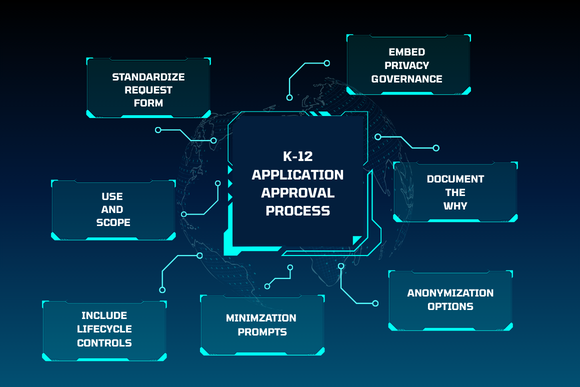
- Formalize an application approval process: require every new app to go through a standardized review for instructional value, security posture, and data minimization.
- Introduce self-sovereign-style selective disclosure: decide what “just enough” information each app really needs—such as “over 13,” “in grade 7,” or “enrolled in Algebra I”—instead of sending full identity records.
- Start tightening scopes: update a small set of high-usage vendors to reduce unnecessary fields and replace global identifiers with context-specific IDs where possible.
By day 60, your district should have a repeatable process for approving, configuring, and documenting apps so student data is shared on purpose, not by habit.
Days 61–90: Operationalize and Automate Governance
In the final 30 days, the focus shifts from policy-writing to practice. You are building the operational rhythm that keeps your program alive.
- Implement monitoring and reporting: centralize logs of which systems access which data, when, and for what stated purpose.
- Pilot tokenization and self-sovereign data patterns: begin routing selected integrations through a neutral orchestration or vault layer where PII is replaced with tokens and de‑tokenization is strictly governed.
- Train front-line stakeholders: help principals, curriculum leaders, and teachers understand how the new approval process, minimization rules, and privacy expectations work in daily practice.
- Establish a governance cadence: set a quarterly review to retire unused apps, tighten scopes, and expand tokenized, self-sovereign-style exchanges over time.
By day 90, you should have more than a binder of policies; you should have an operating model. Data flows are inventoried, approval decisions are documented, access is role-based and auditable, and at least some high-risk connections are moving toward tokenized, district-controlled patterns instead of traditional rostering.
The next step is scaling this foundation, gradually expanding self-sovereign data practices across more integrations so your district can innovate with confidence, not fear.
If your district is ready to move from “under-governed” to actively governed, now is the time to turn your 30–60–90 plan into practice. Talk with your IT and privacy leaders about where visibility is missing, which apps need guardrails, and where tokenization or a self-sovereign data layer could safely mediate student information. When you are ready to explore how an ecosystem orchestration layer can support that journey, SchoolDay can help you put those governance principles to work across your existing ecosystem.
Key Takeaways
- In the first 30 days, districts should focus on visibility: inventorying applications, mapping data flows, and classifying student and staff data by risk level.
- By day 60, districts can formalize governance through written policies, a standardized application approval process, and self-sovereign-style selective disclosure that limits what each vendor receives.
- By day 90, districts should begin operationalizing and automating governance with monitoring, role-based access, tokenized integrations, and a recurring review cadence.
- A 90-day plan will not solve every privacy challenge, but it creates a realistic pathway from reactive compliance to proactive, zero-trust-aligned data governance.